Organic Membranes
Liquid ribbons, irregular openings, fine secondary strands and floating droplets.
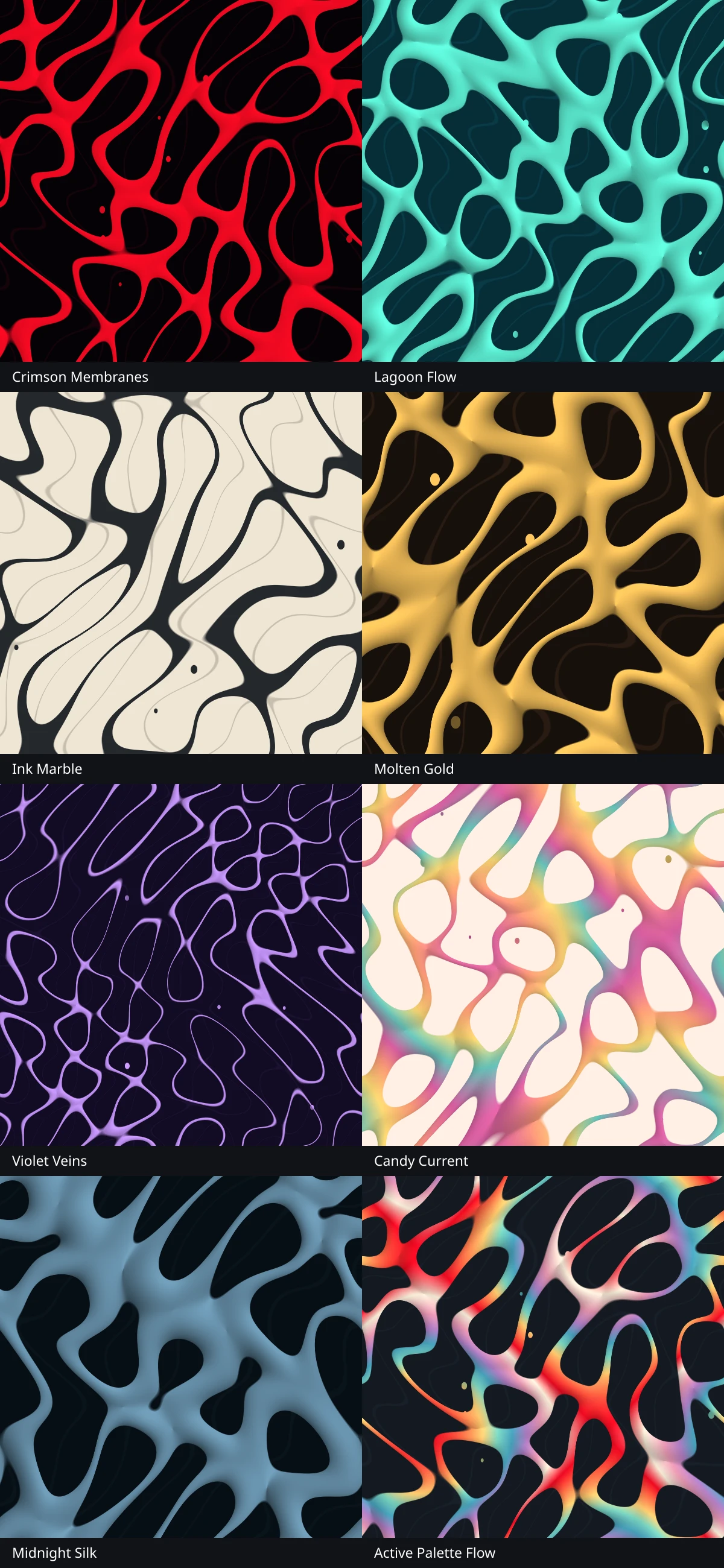
Find Organic Membranes – Seamless under Organic & Natural, or search for its name in the Pattern Library. Eight presets explore graphic red webs, cool lagoons, ink, metallic gold and softly shaded color currents.
Shape the liquid structure
Opening density changes the scale of the underlying flow. Higher values produce more, smaller openings; lower values produce larger ribbons and loops. It is a scale control, rather than an exact hole count.
Ribbon width thickens the liquid web around its openings. Narrow ribbons form delicate veins; thicker ribbons merge into broader sheets. Width variation changes how much the ribbon thickness swells and narrows across the repeat.
Flow bend bends the broad currents. Turbulence introduces more local distortion. Both can reshape and merge openings as the ribbons move through the flow. These are static pattern controls, not animation speeds.
Layout seed makes a particular arrangement repeatable. Shuffle flow finds another layout while keeping the selected colors and other controls. Changing density can also substantially change the layout.
Secondary strands and droplets
Secondary strands adds a finer contour network behind the main ribbons. Its independent Strand color and Strand opacity controls can make the network subtle and dark, or bright and contrasting. Strands may form separate fine loops; they are not outlines around the main ribbons.
Droplets changes the amount of small elliptical accents. At 0 they disappear; higher values increase their density. Droplets share the ribbon colors and remain tied to the layout seed. Some meet or disappear beneath a ribbon.
Color and surface
Color source offers 1–8 Custom colors or Active palette. Every custom ink has a picker and HEX input. Active palette samples up to eight colors spread across the palette bar, using fewer if the palette is shorter. Importing a new palette recolors the ribbons without changing their geometry.
With multiple colors, Color cycles repeats the smooth color blend across the flow. Color phase moves the colors through that field without moving the ribbons. The palette blend closes into a continuous loop. Secondary strands keep their own independent color.
Surface depth adds light and dark shaping to the ribbon faces. Set it to 0 for flat graphic color. Light direction changes the apparent illumination; it has no effect at depth 0. The surface is a stylized relief effect, rather than a physical fluid simulation.
Eight designer presets
- Crimson Membranes: the red-on-black reference look, with dark secondary strands and scattered droplets.
- Lagoon Flow: turquoise raised ribbons over deep blue-green.
- Ink Marble: flat charcoal contours and fine taupe strands on ivory.
- Molten Gold: broad metallic gold ribbons on dark brown.
- Violet Veins: delicate violet webs with fine secondary lines.
- Candy Current: four softly blended pastel inks with no secondary strands.
- Midnight Silk: broad shaded blue ribbons with subdued strands and no droplets.
- Active Palette Flow: multicolor ribbons using the palette bar.
Seamless export and transparency
Transparent background removes the fill between the ribbons, strands and droplets. The preview checkerboard is not exported. Artwork opacity fades the assembled artwork.
Repeat tile size sets the square repeat from 256–2048 pixels. PNG export uses that repeat size. All contour fields, color blends and droplets wrap across both axes. Use Seamless Preview to inspect the repeat and your chosen scale.
The engine carries a Slower badge. The generated tile is cached for unrelated changes. Larger repeat sizes take longer to regenerate; use a smaller tile while exploring, then increase it for export. Origin placement, saved recipes and the global texture and paint overlays follow the usual PatternSmith workflow.